

Polyimide High-Frequency Migration: The Processing Window of Low-Df PI Materials
1. The Df Target and the Process Gap
Polyimide has long been the default substrate where thermal endurance is non-negotiable — satellite payloads, avionics, industrial controls. But conventional polyimide carries a dielectric penalty: Df of 0.012 to 0.017 at 10 GHz, roughly an order of magnitude higher than PTFE or hydrocarbon-ceramic laminates.
For high-frequency migration, the target is Df below 0.005, ideally below 0.003 at 10 GHz. Modified polyimide and low-Df PI systems have reached this range: ester/ether-bonded polyimides at 0.0015–0.0024 at 10 GHz, crosslinked systems at 0.002 across 10–30 GHz, and low-temperature-curable modified polyimide at 0.0016–0.0018 at 20–28 GHz.
The question is not whether low-Df PI exists. It is whether it can be processed into a reliable multilayer board without losing the Df advantage — or the mechanical integrity — during lamination, cure, and sequential build-up.
2. The Processing Window Is Not a Temperature Setpoint
Discussions of PI processing often reduce the window to a single number: cure at 300–380°C at 150–400 psi for conventional high-Tg polyimide. For low-Df PI, that framing is inadequate. The window is a three-way constraint space in which cure chemistry, interfacial adhesion, and dimensional stability each impose limits.
Table 1 — Three constraints defining the low-Df PI processing window
| Constraint | What it limits | Typical low-Df PI behavior |
|---|---|---|
| Cure temperature window | Degree of imidization vs. dielectric degradation | Wide latitude possible; Arlon 86HP supports up to 7 sequential lamination cycles |
| Copper adhesion | Peel strength after plasma/chemical treatment | Low-CTE PI shows weak peel strength due to absent interfacial interactions |
| CTE / dimensional stability | Warpage and registration across build-up | PI Z-axis CTE rises sharply above Tg; CTE matched to copper reduces warpage |
A process window that satisfies only the cure condition is not a manufacturing window. It is a single point that may fail on adhesion or registration.
3. Cure Window: Wider Than Expected, but Not Unlimited
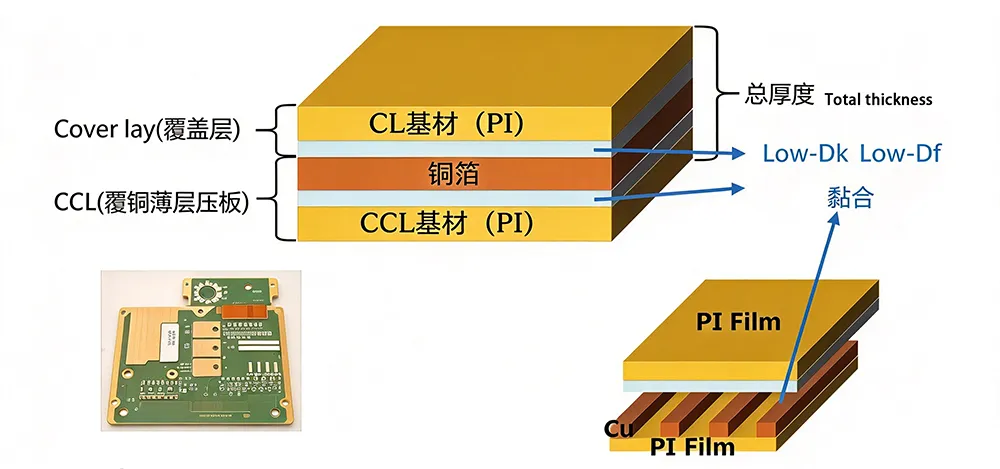
The first surprise of low-Df PI is that the cure window can be wider than conventional polyimide, not narrower. Arlon 86HP is specified with “wide process latitude in lamination curing temperatures,” enabling up to seven sequential lamination cycles without resin degradation. Arlon’s 85N and 85HP are used with as many as six sequential lamination steps without over-cure issues.
This matters because high-layer-count and HDI designs require multiple press cycles. Each cycle is a thermal exposure that can shift Df if the resin continues to cure or degrade. A material with a narrow cure window forces the fabricator to choose between incomplete imidization (poor mechanical properties) and over-cure (Df drift). A wide window decouples these failure modes.
The lower bound of the window is also moving. Low-temperature-curable modified polyimide has been cured at 80–140°C through a radical process, while a low-Df polyimide coverlay specifies fast-press lamination followed by a 160–180°C, 60–90 minute post-cure in nitrogen. A polyimide resin solution cured at 300°C for 30 minutes in N₂ achieves Df comparable to LCP with CTE matched to copper foil.
The practical guidance: specify the post-cure condition as a window, not a peak. Ask the material supplier for Df versus cure temperature and Df versus cumulative thermal exposure data. A window that holds Df within ±0.0005 across the intended number of press cycles is the real specification.
4. Adhesion Window: The Constraint That Low-CTE Chemistry Tightens
The second constraint is adhesion, and it is where low-Df PI becomes genuinely difficult.
The chemical features that reduce Df — rigid backbones, low polar group density, ordered chain packing — also reduce the interfacial interactions that bond polyimide to copper. Low-CTE polyimides exhibit “weak peel strengths between Cu and PI due to the absence of effective interactions” at the interface. A material optimized for dimensional stability and low loss is, by the same molecular logic, a material that resists adhesion.
The industry answer is surface activation, not adhesive additives. Oxygen-CF₄ plasma treatment (1:1 gas) on low-thermal-expansion polyimide increases peel strength from 15 g/cm to at least 500 g/cm — a 30× improvement — and the treated surface retains adhesion in high-temperature, high-humidity environments. Helicon plasma grafting of amino groups raises PI surface roughness by 40–65% and achieves Cu peel strength above 8.0 N/cm.
This is a process-window constraint in the strict sense: plasma power, gas ratio, treatment time, and the interval between treatment and lamination all affect the result. A low-Df PI that receives the plasma treatment specified for conventional PI may underperform, because the surface chemistry it presents to the plasma is different. The adhesion window must be co-developed with the plasma recipe, not inherited from an existing PI process.
5. CTE Window: Where the Df Advantage Meets the Reliability Limit
The third constraint is CTE, and it connects the processing window to the reliability outcome. Polyimide film has a CTE of roughly 25 ppm/°C below Tg, rising to about 40 ppm/°C above Tg. Copper is approximately 17–19 ppm/°C. Above Tg, the mismatch between dielectric and copper expands, and the Z-axis strain is driven into microvias and plated through-holes.
Low-Df PI formulations that match CTE to copper — a stated design goal of the Resonac polyimide resin, which shows copper-like expansion up to about 300°C — reduce warpage and improve dimensional stability in fine-line patterning. But this CTE match is not free: the same rigid, ordered chemistry that lowers CTE also suppresses adhesion, as noted above.
The processing window must therefore hold both properties simultaneously. A cure schedule that produces excellent Df but leaves the resin above its Tg during subsequent thermal cycling will erase the CTE advantage. A post-cure that maximizes adhesion through extensive surface roughening may increase conductor loss and degrade the high-frequency benefit.
6. What This Means for Fabrication and Material Selection
Do not specify low-Df PI by Df alone. Require Df after the full intended thermal history — cure plus all sequential lamination cycles — not just datasheet Df after a single press.
Qualify the plasma recipe against the specific PI chemistry. The 30× adhesion improvement from O₂-CF₄ plasma on low-CTE PI is not transferable without re-optimization for each low-Df formulation.
Verify CTE above Tg, not just at room temperature. The Z-axis expansion above Tg is where microvia and PTH stress accumulates. A material with excellent room-temperature CTE can still fail if the above-Tg CTE is poorly controlled.
Treat the number of lamination cycles as a process-window variable. A material rated for 7 sequential laminations may still show Df drift after cycle 4 if the cure window is not respected. Ask for Df versus cycle-count data, not just a maximum cycle rating.
A low-Df PI that reaches 0.002 at 10 GHz is a materials achievement. A low-Df PI that holds 0.002 after five press cycles, survives plasma treatment with adequate peel strength, and maintains CTE-matched expansion above Tg is a manufacturing capability. The gap between the two is the processing window — and it is narrower than the datasheet suggests.
7. Frequently Asked Questions:
Q1: What Df can low-Df polyimide achieve at 10 GHz?
A: Modified polyimides with ester and ether bonds reach Df of 0.0015–0.0024 at 10 GHz; crosslinked systems achieve 0.002 across 10–30 GHz; low-temperature-curable MPI reaches 0.0016–0.0018 at 20–28 GHz.
Q2: Does low-Df PI require a narrower cure window than conventional PI?
A: Not necessarily. Arlon 86HP offers wide process latitude in lamination curing temperatures and supports up to 7 sequential lamination cycles. The constraint is not window width but whether Df remains stable across the full thermal history.
Q3: Why does low-CTE PI have weak copper adhesion?
A: The rigid, ordered chain packing that lowers CTE and Df also reduces interfacial interactions with copper. Low-CTE polyimides show weak peel strength due to the absence of effective Cu–PI interactions.
Q4: How is copper adhesion improved on low-Df PI?
A: O₂-CF₄ plasma treatment (1:1) increases peel strength from 15 g/cm to at least 500 g/cm, a 30× improvement that persists in high-temperature, high-humidity environments. Helicon plasma amino grafting achieves >8.0 N/cm peel strength.
Q5: What CTE does polyimide have relative to copper?
A: Polyimide film has CTE of approximately 25 ppm/°C below Tg and about 40 ppm/°C above Tg; copper is approximately 17–19 ppm/°C. Above-Tg mismatch drives microvia and PTH stress.
Q6: Can low-Df PI be processed at low temperature?
A: Yes. Low-temperature-curable MPI has been cured at 80–140°C, and low-Df polyimide coverlay specifies fast-press lamination with a 160–180°C, 60–90 minute post-cure.
Q7: What is the main risk of multiple sequential lamination on low-Df PI?
A: Over-cure and resin degradation, which can shift Df and mechanical properties. Materials with wide cure latitude — such as those rated for 6–7 sequential cycles — mitigate this risk.
Q8: Is Df measured after a single press representative of the final board?
A: No. The final board experiences cure plus multiple press cycles. Df must be specified after the full intended thermal history, not just the datasheet condition.
Q9: What plasma parameters matter for low-Df PI adhesion?
A: Gas ratio (O₂-CF₄ 1:1 is reported), treatment time, power, and the interval between treatment and lamination. The recipe must be re-optimized for each PI chemistry, not inherited from conventional PI.
Q10: Does a CTE-matched low-Df PI solve the dimensional stability problem?
A: It reduces warpage and improves registration in fine-line patterning, but the CTE match must hold above Tg, where expansion accelerates. Room-temperature CTE data alone is insufficient.
8. About Richfulljoy
Richfulljoy supports high-frequency and high-reliability programs with polyimide-based PCB manufacturing, including low-Df PI material evaluation, plasma-enhanced adhesion processes, and sequential lamination window development for modified polyimide systems.